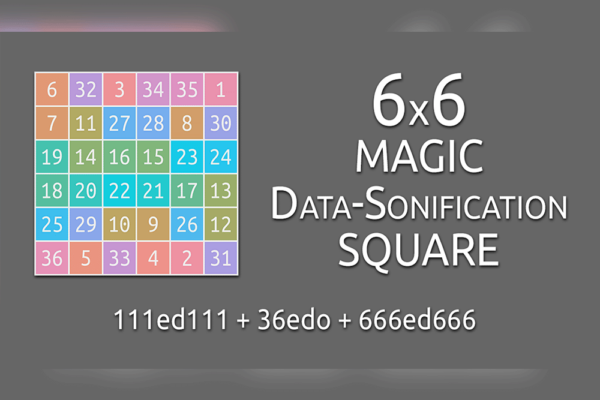
microtonality
Sulphuric Microtonality | 16edo Alchemy
An alchemy-inspired exploration of the octave divided into 16 equal parts. 16edo microtuning was chosen because it is the atomic number for Sulphur (S).
Saltedo Dissonance | 11Edo + 17Edo
The dissonant intervals possible when overlapping multiple tuning systems. Specifically 11Edo and 17Edo. 11 and 17 were chosen because they are the atomic numbers for Na (Sodium) and Cl (Chloride) respectively.
Pogson’s Octave | ~ 9.0309-TET ~ 132.877 cents/semitone
Pogson’s Ratio (the fifth root of 100) refers to the logarithmic Magnitude scale used to classify the brightness of celestial bodies.
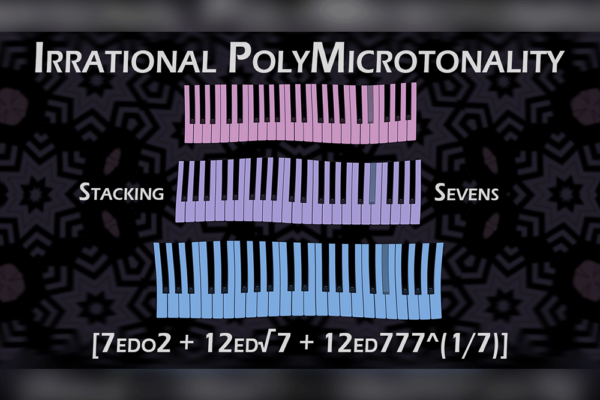
Nakshatra Lords in 9/4 | Polyrhythmic Polymicrotonality
Algorithmic Composition featuring six simultaneous equal temperaments: 27Edo, 12Edo, 9Edo, 7Edo, 5Edo, and 4Edo.
Midnight’s Templar | Sinusoidal Microtonality in 5° Intervals
Exploration of a 36-note double-octave in sinusoidal tuning.
Dark Microwave | Octadecatonic
Created using a 2-octave, 18-note scale with intervals inspired by Benford’s Law (a.k.a. The Newcomb-Benford Law, the law of anomalous numbers, or the first-digit law).
Shrunken Octave Whaling Vessel | Harmonic-Interval Octave
An experiment with systematized composition.
A Trip to PRS with a Circle of Augmented 5ths | 36-EDO
36-EDO dreamgaze in 7/8 time around a Circle of Augmented 5ths. The Circle of Augmented 5ths in 36-EDO is similar to the Circle of 5ths in 12-EDO. But instead of a non-repeating coprime cycle of 7:12, we use 23:36 instead. The video is a slideshow from a recent trip to The Philosophical Research Society founded…